Surgical teaching systems can significantly improve the quality of surgical education and reduce the infection risks associated with in-person observation. Medical institutions broadly recognize these benefits. Yet when it comes to implementation, hospitals and system integrators often face the same question: with so many solutions on the market, how should they evaluate them?
This article sets out five priorities to check when evaluating a surgical teaching system. They can help you identify potential problems before signing a contract.
1. Can the System Work with Existing Operating Room Infrastructure Without Major Renovation?
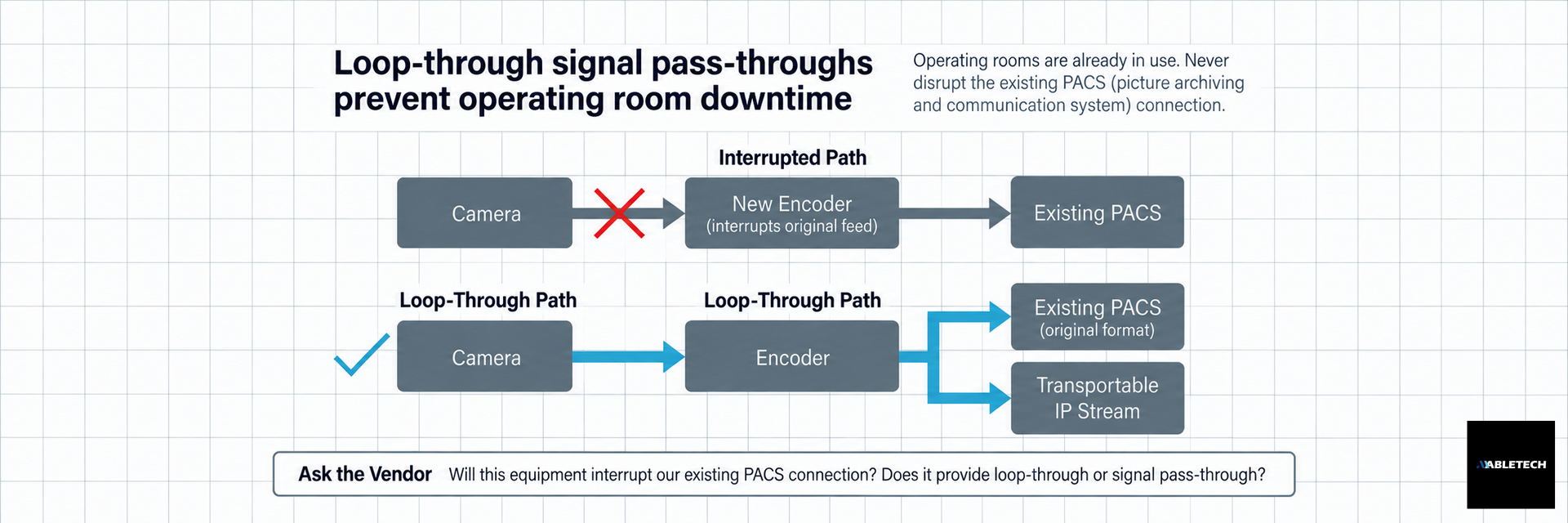
Most operating rooms are already in use. They have cameras and endoscopes, and their video feeds reliably reach PACS (picture archiving and communication system). The first question when evaluating a teaching system is whether new equipment will affect the existing signal path.
Ideally, choose signal conversion equipment, such as an NDI encoder, with a loop-through output. As it captures video and converts it to a transportable IP stream, it also passes the original signal through in the same format to the existing PACS or recording system. The new teaching path is added alongside the current one rather than replacing it. This avoids having to reconfigure the operating room’s existing medical imaging equipment.
Ask the vendor: Will this equipment interrupt or change our existing PACS connection? Does it provide loop-through or signal pass-through?
2. Is Latency Low Enough for Live Teaching Interaction?
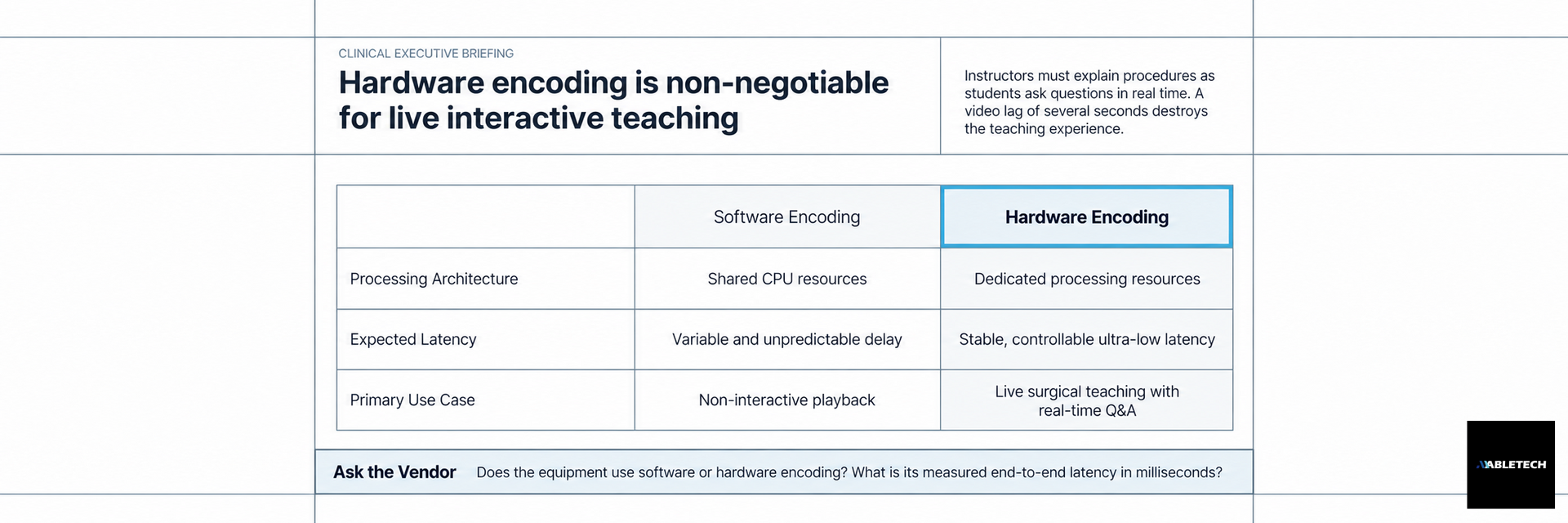
Surgical teaching is not simply one-way playback. Instructors need to explain what is happening as students ask questions in real time. If video lags by several seconds, the teaching experience suffers and the instructor may struggle to describe the procedure as it unfolds.
Latency depends largely on how the signal is converted. Software encoding, which runs transcoding software on a computer, can be affected by the computer’s resources and other programs, making delay less predictable. Hardware encoding uses dedicated processing resources and can provide more stable, controllable latency. If live interaction is central to the teaching program, prioritize a hardware encoding solution.
Ask the vendor: Does the equipment use software or hardware encoding? What is its measured end-to-end latency in milliseconds?
3. Do Network Bandwidth and Cabling Fit the Site?
Before introducing a teaching system, assess the network between the operating room and the classroom:
● Can the existing hospital LAN be used, or will new cabling be needed?
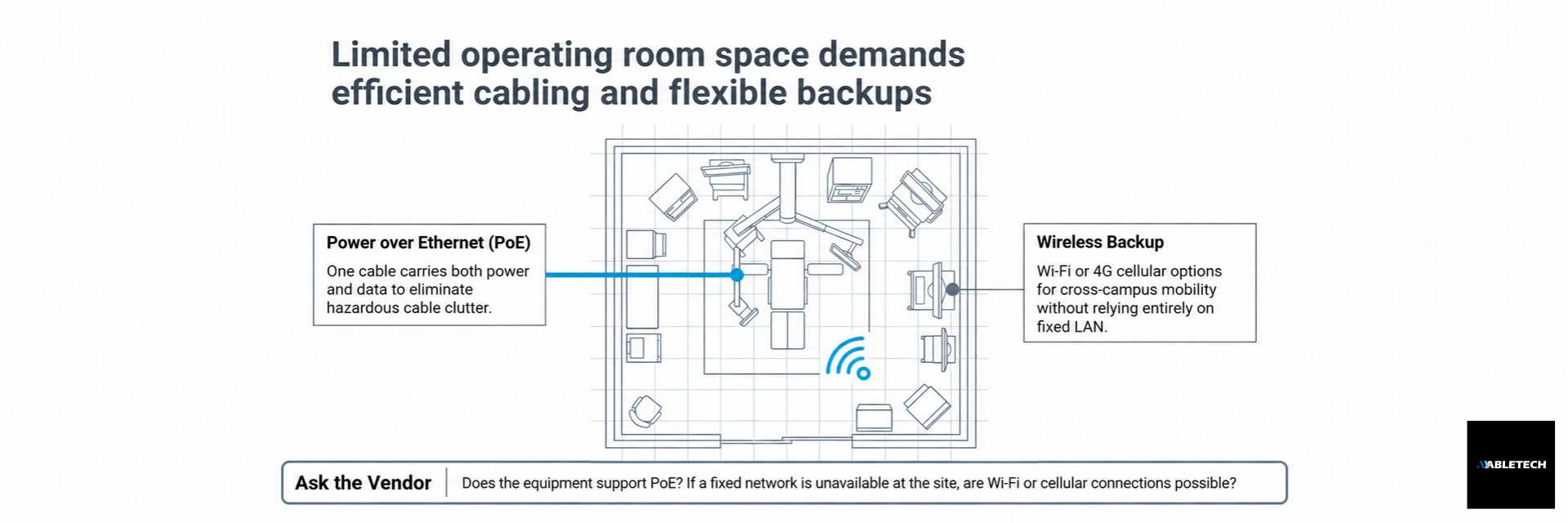
● Is power convenient? Space in an operating room is limited. If equipment supports Power over Ethernet (PoE), one network cable can carry both power and data, avoiding an additional power cable.
● Is wireless or cellular backup needed? If teaching locations vary, such as across different classrooms or hospital campuses, consider a flexible Wi-Fi or 4G option rather than relying entirely on fixed network connections.
Ask the vendor: Does the equipment support PoE? If a fixed network is unavailable at the site, are Wi-Fi or cellular connections possible?
4. Can the Architecture Expand to More Operating Rooms and Classrooms?
Many hospitals begin with a pilot linking one operating room to one classroom. Over time, they may want to connect more rooms or stream to partner institutions. Check these expansion questions early:
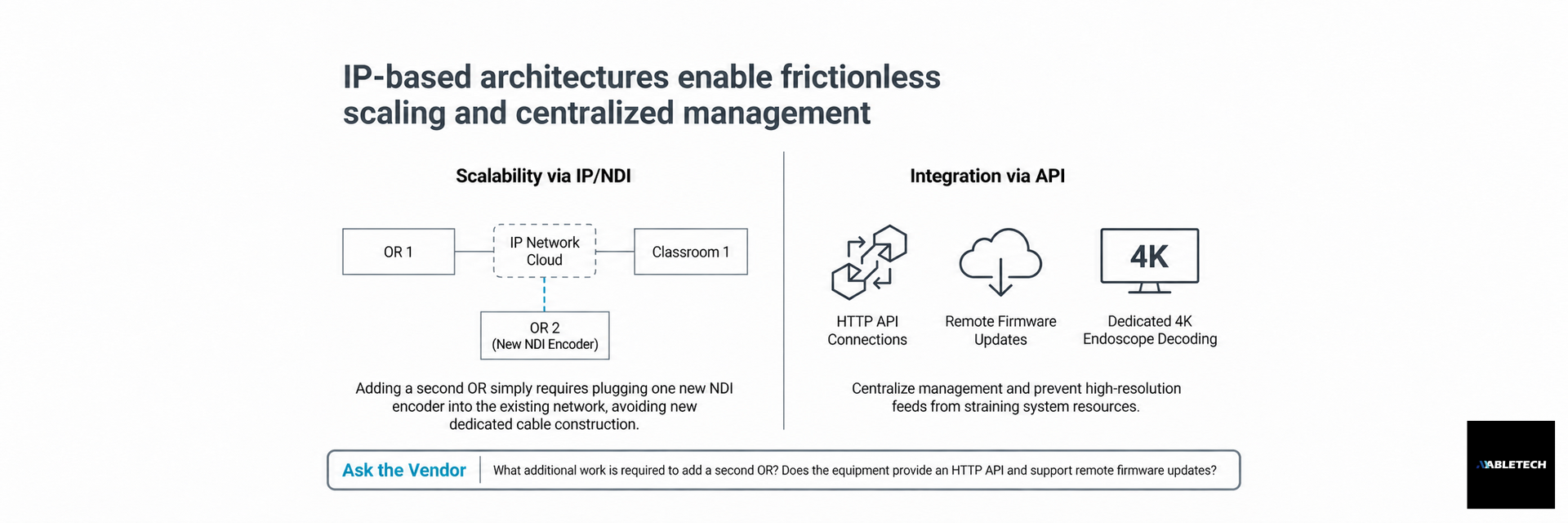
● Does video travel over an IP network? With an IP-based system such as NDI, adding a video source generally means adding an encoder and using the existing network, rather than running a new dedicated cable for every expansion.
● Can multiple devices run in parallel and be managed centrally? Check whether devices can be assigned unique identifiers and whether a central management interface is available.
● Is there a path to external live streaming? If doctors outside the classroom may need to participate, confirm that the system can connect to a streaming encoder and publish to an internal platform or external streaming server.
● der and publish to an internal platform or external streaming server.
Ask the vendor: What additional work would be required to extend this architecture to a second or third operating room?
5. Can It Integrate with Existing Hospital IT and AV Management?
Implementation does not end when the equipment is installed. Ongoing operations and maintenance matter as well. For hospital IT and AV teams, the ability to include devices in existing management systems directly affects long-term efficiency:
● Is an API available? It lets system integrators connect devices to the hospital’s network management platform for centralized monitoring, configuration, and scheduling.
● Are remote management and firmware updates supported? They reduce the effort required to maintain devices one at a time on site.
● Can high-resolution sources such as endoscopes be processed separately? Decoding several high-resolution feeds on one workstation can strain its resources. A dedicated decoder output for a priority source, such as a 4K endoscope, can leave processing capacity for production and recording.
Ask the vendor: Does the equipment provide an HTTP API? Can it be managed remotely and have its firmware updated remotely?
Quick Checklist of the Five Priorities
Evaluation priority | Question to ask |
Existing infrastructure compatibility | Will it affect the existing PACS connection? Does it have loop-through? |
Latency | Does it use hardware or software encoding? What is the measured latency? |
Network and cabling | Does it support PoE? Is Wi-Fi or cellular backup available? |
Expansion | Would adding more operating rooms require additional construction or cabling? |
System integration | Is there an API? Are remote management and firmware updates supported? |
Frequently Asked Questions
Q1: Does a surgical teaching system have to use NDI? No. However, IP-based technologies such as NDI are a common option because they can use existing networks and offer flexibility for expansion, particularly when upgrading an existing operating room.
Q2: Will implementation require operating room downtime? With signal conversion equipment that offers loop-through, installation typically involves adding a device to the existing signal path rather than reconfiguring the original connections. This can substantially reduce disruption, although the actual installation plan should be confirmed on site.
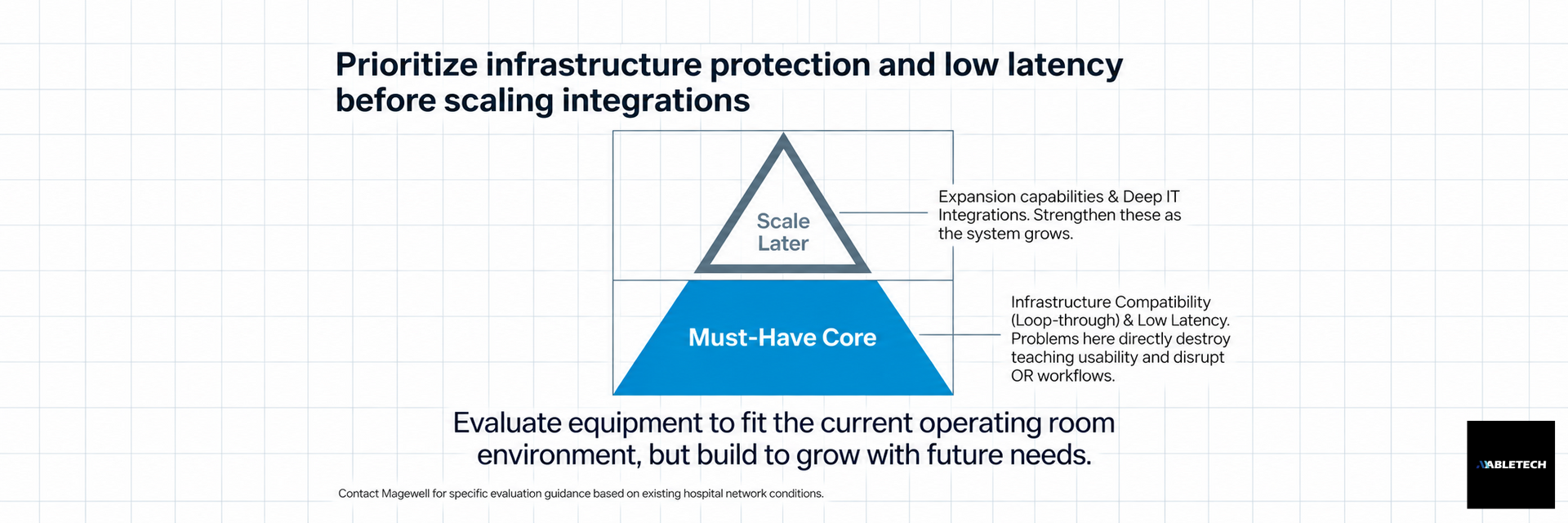
Q3: With a limited budget, what should we prioritize? Start by checking compatibility with existing infrastructure and latency requirements. Problems in either area directly affect teaching usability and operating room workflows. Expansion and integration capabilities can then be strengthened as the system grows.
Conclusion
Evaluating a surgical teaching system is about more than comparing feature lists. The central question is whether it can fit the current operating room environment and grow with future needs. Use these five considerations to ask vendors focused questions and avoid discovering expansion limits after installation. If you are planning a surgical teaching system, contact us. We can offer specific evaluation guidance based on your existing equipment and network conditions.