
In recent years, hospitals have increasingly adopted digital surgical education instead of having medical students and residents crowd into operating rooms to observe procedures. This can improve the quality of surgical care and reduce infection risks. Yet the greatest obstacle is often the existing operating room itself. Most established surgical teaching systems are planned, wired, and equipped alongside new operating rooms. For an operating room already in use, the real challenge is adding a stable, reliable live teaching system without changing its picture archiving and communication system (PACS) or existing cabling.
This article introduces a solution designed for existing operating rooms. It combines Magewell Pro Convert NDI encoders with an Ultra Stream live streaming encoder to send operating room video to a classroom in real time, and even stream it to external viewers, without changing the original equipment or PACS connections.
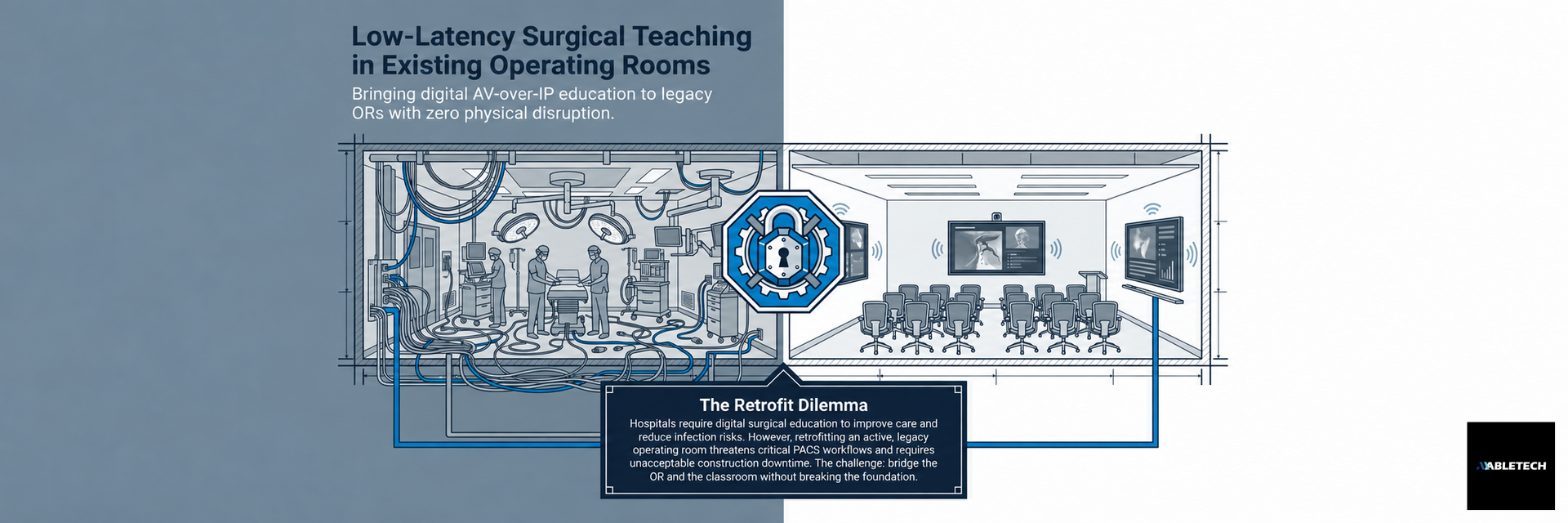
What Makes Surgical Education Difficult in Existing Operating Rooms
Most operating rooms already have surgical field cameras, room cameras, endoscopes, and other medical imaging equipment. Their video is already reliably delivered to PACS storage and internal hospital systems. Adding a separate live teaching system raises several concerns:
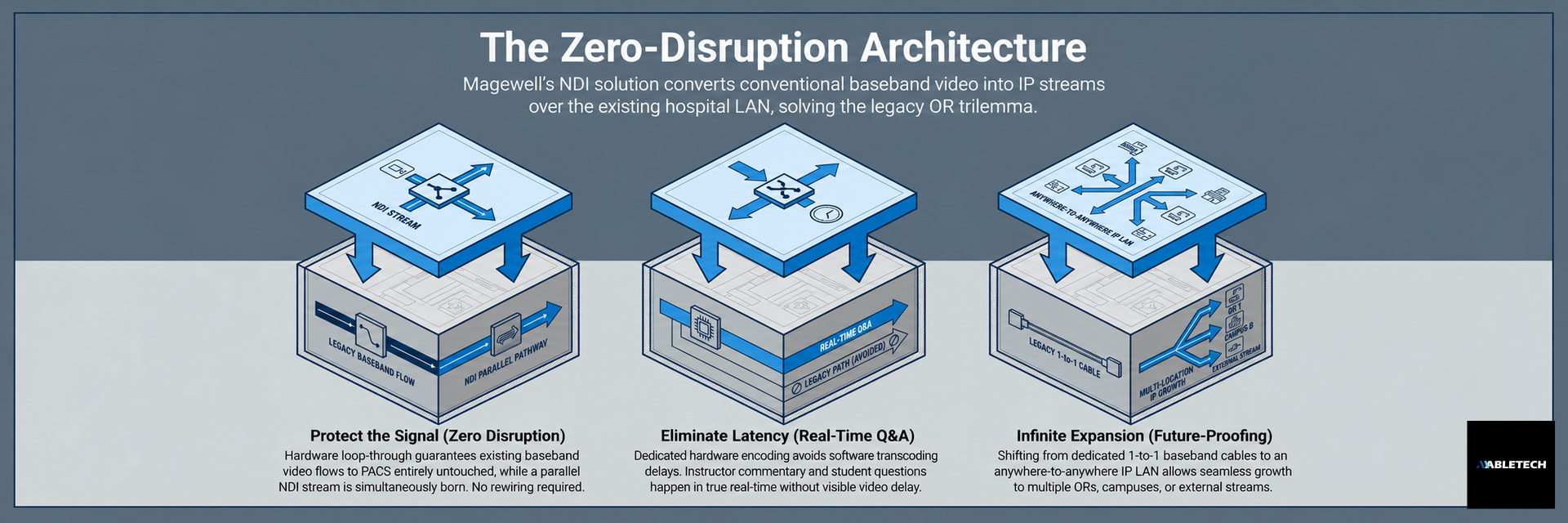
Protecting the original signal: New equipment must not disrupt the existing PACS signal path or require rewiring and construction downtime.
Meeting latency requirements: Surgical teaching involves real time interaction, including instructor commentary and student questions. Excessive video delay undermines that experience.
Planning for expansion: A project may begin with one teaching classroom, then grow to multiple operating rooms or external live streams. Its architecture must support that growth.
Meeting all three requirements—preserving existing infrastructure, low latency, and expandability—depends on the right signal transport method. Converting conventional baseband video into IP streams that travel over the hospital's existing local area network (LAN) is where NDI (Network Device Interface) technology and NDI encoders come in.
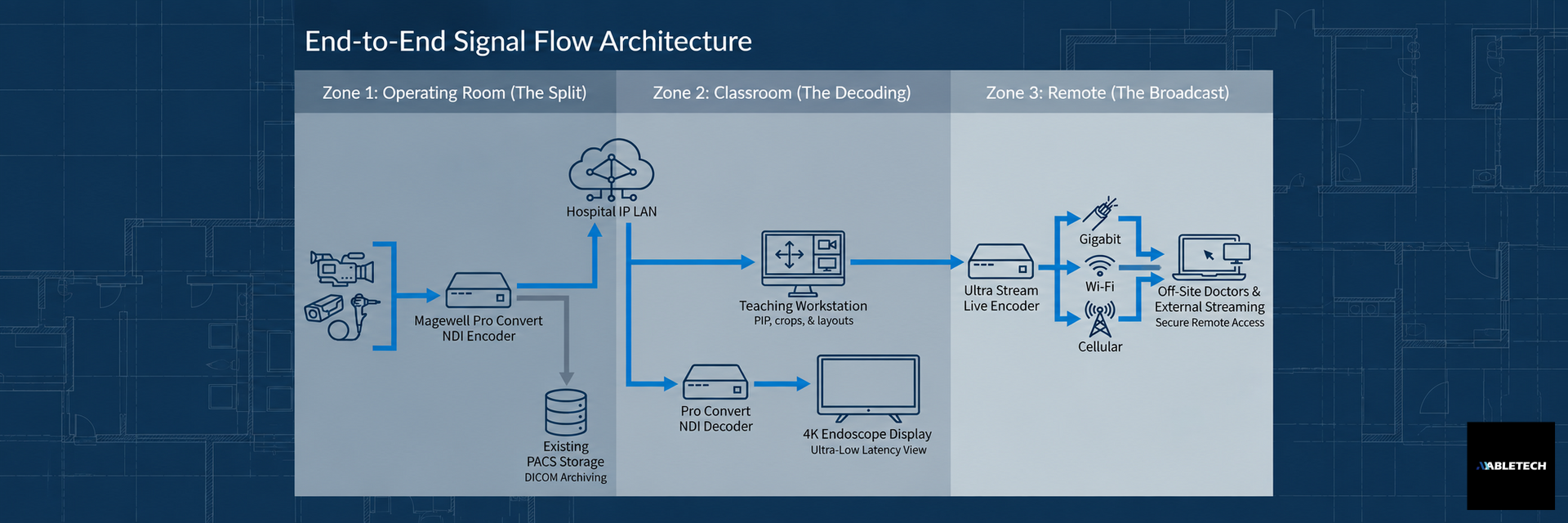
Solution Architecture from Operating Room to Classroom
The solution has two parts: the operating room and the classroom.
Operating room: One or more Magewell Pro Convert NDI encoders receive HDMI or SDI signals from surgical field cameras, room cameras, endoscopes, and other devices. They encode the video locally into low latency NDI streams and transmit them over the hospital's existing LAN. The original signals also pass through to the operating room's existing PACS system, preserving the established image storage workflow.
Classroom: A surgical teaching workstation receives the NDI streams and uses its software to create picture in picture views, crops, and scaled layouts. If the workstation supports NDI, it can decode and play the streams directly. Otherwise, a Magewell Pro Convert NDI decoder can convert the streams back to baseband signals for the workstation. The finished program goes to a projector or display for doctors and students in the classroom. To include doctors who are off site, the workstation can also send its output to an Ultra Stream live streaming encoder, which publishes the stream to an internal platform or an external streaming server.
The principal advantage is that the operating room only needs added Pro Convert NDI encoders. Its cameras, endoscopes, and PACS connections can remain in place, making this an addition to the existing installation rather than a complete rebuild.
Core Technology One Pro Convert NDI Encoders and Decoders Bring Baseband Video into IP Workflows
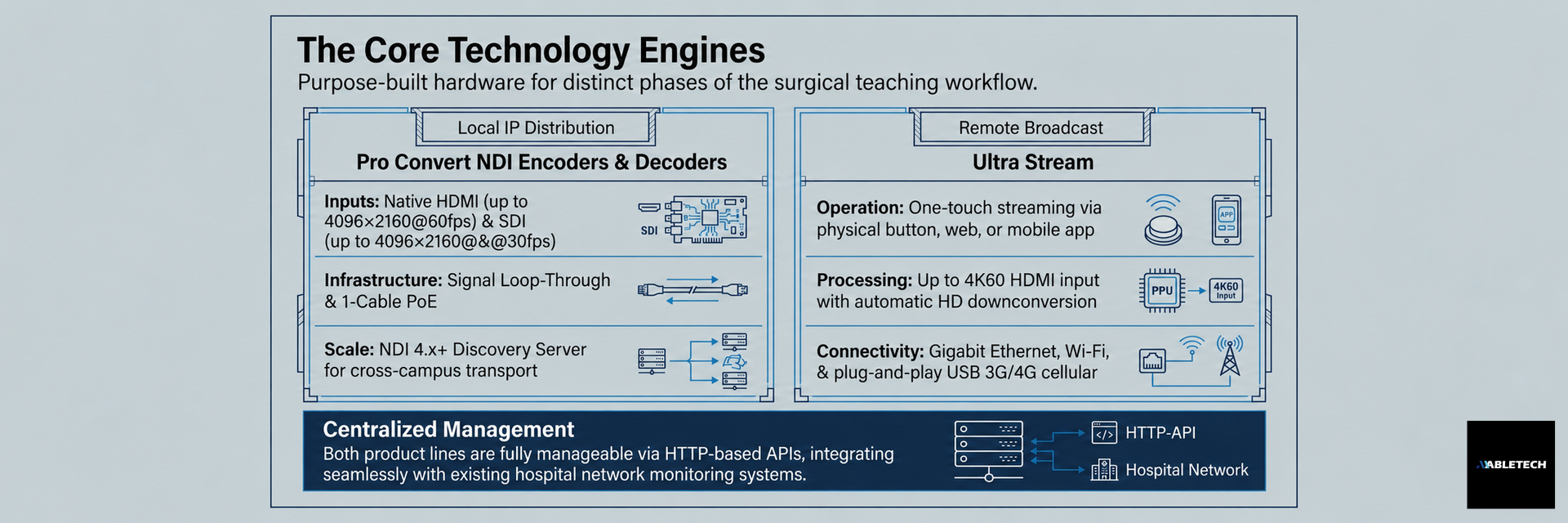
Magewell Pro Convert NDI encoders, such as the Pro Convert HDMI 4K Plus and Pro Convert SDI 4K Plus, help the solution preserve existing infrastructure while supporting low latency video:
Native HDMI and SDI inputs with up to 4K60 support: They connect directly to existing HDMI or SDI medical imaging devices. The HDMI model supports up to 4096 × 2160 at 60 fps, while the SDI model supports up to 4096 × 2160 at 30 fps, accommodating 4K endoscopes and high resolution cameras.
Signal loop through: While capturing and converting the video to an NDI stream, the encoder outputs the original signal through its loop through connection in the same format. This output can feed the operating room's existing PACS system without redesigning the signal path.
Simpler cabling with PoE: IEEE 802.3af Power over Ethernet supplies power and data through one network cable, reducing the need for additional power cabling in the operating room.
Low latency for live interaction: Hardware encoding avoids software transcoding and helps keep communication between the operating room and classroom timely, so visible video delay does not interrupt explanations and questions.
Multiple devices in parallel: Hospitals can deploy several Pro Convert devices in one or more operating rooms as needed. Their NDI streams share the internal IP network, avoiding a dedicated cable for each signal and simplifying expansion to more rooms and classrooms.
If the endoscope feed is the teaching team's main priority, a Magewell Pro Convert NDI decoder in the classroom can decode that stream from the LAN and output it directly to a projector or display. The teaching workstation then does not need to handle both decoding and multiple baseband outputs, leaving computing capacity for encoding, production, and recording. This is especially useful for data intensive 4K endoscope video. In addition, newer NDI versions (4.x and later) include Discovery Server functionality that supports discovery and transport between network segments, helping hospitals connect teaching systems across different network areas or campuses.
Core Technology Two Ultra Stream Extends Surgical Teaching Beyond the Classroom
When doctors and learners at other locations also need to watch, the Magewell Ultra Stream live streaming encoder provides a path to remote delivery:
One touch streaming: Doctors can start a live stream using a physical button on the device, its built in web interface, or a mobile app, without specialist streaming expertise.
Up to 4K60 HDMI input with HD downconversion: The encoder accepts a 4K output from the teaching workstation and can downconvert it to HD for streaming, balancing picture quality and available bandwidth.
Flexible network connections: Gigabit Ethernet and Wi-Fi are supported, with an optional plug and play USB 3G or 4G cellular modem. Cellular connectivity can enable streaming where fixed network access in an operating room, classroom, or temporary venue is limited or tightly controlled.
Distributed Deployment and Integration for Future Growth
Beyond a single operating room and classroom, the Pro Convert NDI encoder and decoder devices and Ultra Stream support a distributed deployment. Hospitals can add operating rooms, connect more teaching classrooms, or send teaching video to an internal recording and archive system using the same NDI backbone, without redesigning signal transport each time.
For system integrators and hospital IT or AV teams, Magewell also offers HTTP based APIs to integrate Pro Convert and Ultra Stream devices with existing network management systems. Centralized monitoring, configuration, and scheduling can reduce ongoing maintenance effort.
Frequently Asked Questions
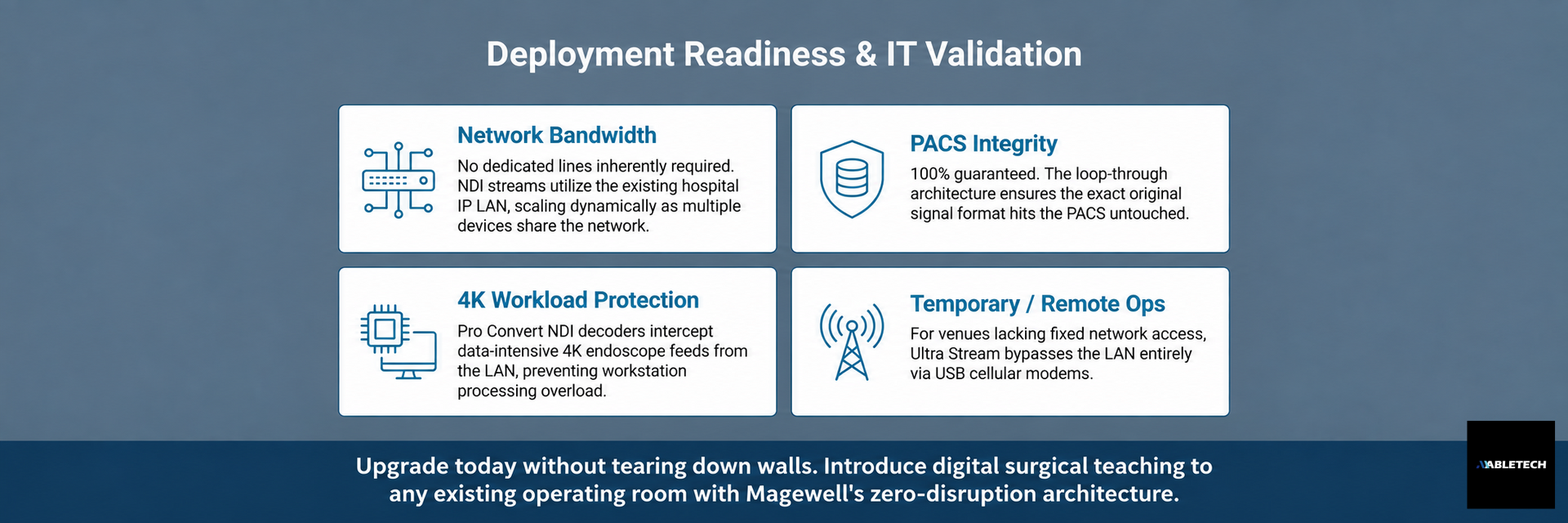
Q1: Will adding an NDI encoder affect the existing signal to PACS? The Pro Convert NDI encoder captures the original signal and passes it through to the existing PACS system in the same format. The intended setup preserves the current connection; the exact wiring and compatibility should be confirmed during installation.
Q2: Is the existing operating room network bandwidth sufficient? Is a new dedicated line needed? NDI streams can travel over the hospital's existing IP LAN, and multiple Pro Convert devices can share that network. A dedicated cable for every video feed is not inherently required, although available bandwidth and network configuration should be checked for the planned number of streams.
Q3: Can we stream from a venue without a fixed network connection, such as a temporary teaching space? Yes. Ultra Stream supports Wi-Fi and an optional USB 3G or 4G cellular modem, so it can publish a live stream when a suitable fixed connection is unavailable.
Q4: Will a 4K endoscope feed overload the teaching workstation? A Pro Convert NDI decoder can decode the endoscope stream and output it directly to a display, bypassing the teaching workstation for that feed. This can reduce the workstation's decoding load and reserve processing capacity for production and recording.
Conclusion
Hospitals do not need to wait for a new operating room to introduce digital surgical teaching. Magewell Pro Convert NDI encoders and decoders, together with an Ultra Stream live streaming encoder, can deliver operating room video to a classroom with low latency and extend it to remote viewers while retaining existing PACS cabling and equipment. The architecture can also grow to support more operating rooms and classrooms. If your hospital is considering a digital teaching upgrade for an existing operating room, contact us to discuss an equipment configuration and deployment approach suited to your site.